Every investor entering Gelephu Mindfulness City (GMC) carries the same quiet question: if something goes wrong, where do I stand? It’s the right question to ask.
Contracting in GMC involves a new and distinctive legal environment, which makes your choice of governing law, courts, and dispute-resolution method one of the most important decisions in your deal.
When you’re drafting or negotiating contracts, it’s important for businesses to think about the key GMC contracting factors that this guide covers, so you can reduce legal uncertainty, protect your interests, and build stronger commercial relationships from the very beginning.
Why Contract Drafting in GMC Requires Care
GMC was established as a highly autonomous Special Administrative Region under the Royal Charter in 2024. GMC’s official website states that the SAR has executive and legislative powers and an independent judiciary.
Its legal framework is also not simply a copy of Bhutan’s general legal system or a blanket application of Singapore law.
The current GMC legislation page lists, among other laws:
- Application of Laws Act 2024
- Companies Act 2025
- Employment Act 2025
- Financial Services Act 2025
- Income Tax Act 2025
- Sale of Goods Act 2026
- Unfair Contract Terms Act 2026
- Limited Liability Partnerships Act 2026
- Partnership Act 2026
The page also lists amendments to the Application of Laws Act in 2025 and 2026.
This means a GMC governing law and jurisdiction analysis should start with the current GMC legislation, rather than assuming that a standard Bhutanese or foreign contract clause will automatically produce the intended result.
What Does Governing Law Mean?
The governing law is the legal system used to determine the parties’ contractual rights and obligations and to interpret the agreement.
Depending on the applicable law, it can affect:
- Contract formation
- Interpretation
- Terms and conditions
- Terms that are implied
- Violation
- Termination
- Damages
- Clauses that limit liability
- Clauses that leave out any liability
- Transfer of rights
- Third-party rights
- Remedies available under the contract
Governing law is not the same as jurisdiction.
For example, a contract could specify one legal system as its governing law while providing for disputes to be resolved by arbitration seated in another jurisdiction. Whether that combination is appropriate depends on the transaction and applicable mandatory rules.
What Law Applies in GMC?
There is no single shortcut answer to the question, “What law governs GMC contracts?”
The starting point is the GMC’s own legislation and the framework established by the Application of Laws Act 2024, as amended.
Start With GMC Legislation
GMC maintains an official legislation portal listing the laws currently applicable in the SAR. This should be the first reference point when reviewing a GMC contract.
For commercial contracts, relevant legislation may include the Companies Act, the Sale of Goods Act, the Unfair Contract Terms Act, and other legislation applicable to the particular transaction.
The contract should therefore be reviewed against the law that actually governs its subject matter.
Understand the Application of Laws Act
The Application of Laws Act 2024 provides a framework for determining which external laws apply within GMC.
The Act specifies Singapore enactments that apply in GMC, including legislation concerning companies, contracts involving third-party rights, electronic transactions, employment, personal data, sale of goods and unfair contract terms.
It also provides for Abu Dhabi Global Market (ADGM) laws in specified areas, particularly in the financial-services context, subject to the Act and GMC’s own legislative powers.
For matters not otherwise governed by the specified frameworks, the Act states that Bhutanese law continues to apply. In contrast, Singapore law has presumptive effect for civil and commercial matters, subject to modifications required for application in GMC.
This is why saying simply “GMC uses Singapore law” is too broad.
The applicable law is determined by the relevant GMC legislation, the Application of Laws Act, the nature of the transaction, and any valid contractual choice of law.
Financial Services Require Additional Analysis
Financial-services contracts require particular care.
The Gelephu Financial Services Office (GFSO) regulates financial services and digital-asset activities in GMC. GMC states that its current Financial Services Act 2025 and associated rulebooks govern regulated financial activities, while the earlier phase of the framework drew on ADGM laws.
A financial-services contract may therefore need to be reviewed against:
- GMC legislation.
- Financial Services Act 2025.
- Applicable GFSO rulebooks.
- Licensing conditions.
- Applicable Singaporean provisions.
- Applicable ADGM-derived rules.
- Contractual governing law.
- Mandatory regulatory requirements.
Governing Law vs Jurisdiction vs Arbitration
These concepts are often confused.
| Concept | What it answers |
| Governing law | Which legal rules govern the contract? |
| Jurisdiction | Which court has authority to hear the dispute? |
| Arbitration | Will the dispute be decided by a private arbitral tribunal instead of a court? |
| Seat of arbitration | What is the legal place of the arbitration and which courts supervise it? |
| Hearing venue | Where will hearings physically or virtually take place? |
| Enforcement | Where and how will the judgment or award be recognised and enforced? |
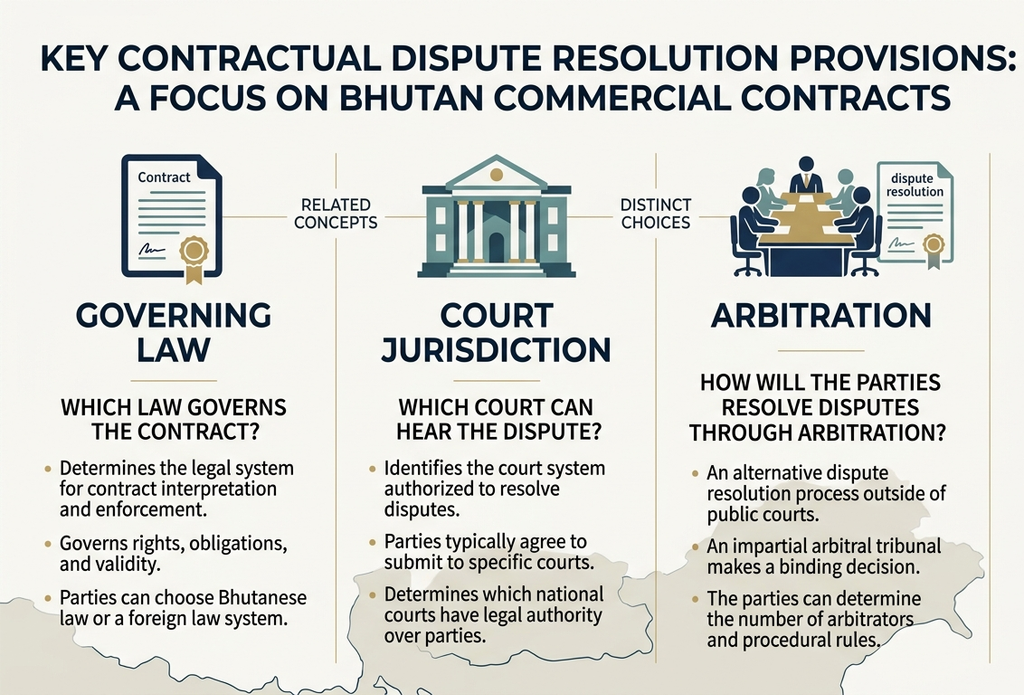
Governing Law Options for GMC Contracts
Depending on the transaction, the parties may consider different governing-law approaches.
| Governing-law approach | Potential reasons for considering it | Key issue |
| GMC law | Direct connection with the place of business or transaction | Identify the applicable GMC legislation precisely |
| Bhutanese law | Relevant where Bhutanese parties, rights or obligations are involved | Check its interaction with GMC’s separate framework |
| Singapore law | Relevant because specified Singapore enactments apply in GMC | Do not assume all Singapore law applies automatically |
| ADGM-derived law | Potentially relevant to regulated financial activities | Confirm the specific legal and regulatory basis |
| Another foreign law | May suit an international transaction | Check mandatory GMC rules and enforcement |
The right choice depends on the transaction, not simply the parties’ nationality.
How to Draft a Governing-Law Clause
Here’s a simple example structure, just for illustration:
This Agreement, along with any non-contractual duties that come from it or are connected to it, will be governed by [identified law], but it remains subject to any mandatory provisions of applicable law within Gelephu Mindfulness City.
This is only an example. A transaction-specific clause may need to address:
- Contractual and non-contractual obligations.
- The precise legal system selected.
- Mandatory GMC provisions.
- Related agreements.
- Guarantees.
- Security documents.
- Arbitration agreements.
- Priority between transaction documents.
Avoid vague wording such as:
- “International law governs this Agreement.”
- “GMC principles shall apply.”
- “Bhutanese and GMC law shall apply.”
- “Applicable common law governs.”
Unless the contract and applicable legislation clearly define these phrases, they can create unnecessary uncertainty.
What Is a GMC Jurisdiction Clause?
A jurisdiction clause determines which court or courts may hear a dispute.
Common methods include:
Exclusive jurisdiction
The parties agree that a specific court or courts will hear any disputes, as allowed by applicable law.
Non-exclusive jurisdiction
The named court is available to hear the dispute, but the clause does not necessarily prevent proceedings in another competent forum.
Asymmetric jurisdiction
One party receives broader rights to bring proceedings in different forums than the other. This arrangement is occasionally found in international financing documents and demands close examination of its enforceability.
A GMC jurisdiction clause should specify:
- The applicable court.
- The geographic jurisdiction.
- Whether jurisdiction is exclusive.
- The disputes covered.
- Whether non-contractual claims are included.
- The key question is whether claims outside the contract are covered.
- Whether the chosen forum can grant the required remedy.
GMC Courts, Bhutanese Courts, Foreign Courts, or Arbitration?
No single forum fits every GMC contract.
| Forum | When it may be considered | Questions to assess |
| GMC courts | Contract and operations have a strong GMC connection | What court has jurisdiction and what remedies are available? |
| Bhutanese courts | National-law issues, Bhutanese parties or assets are involved | How does the GMC connection affect jurisdiction? |
| Foreign courts | Parties, financing or assets are located abroad | Will the resulting judgment be recognised where enforcement is required? |
| Arbitration | Cross-border or technically complex disputes | What seat, rules, tribunal and enforcement mechanism should apply? |
The analysis should consider the location of the parties, assets and project, the nature of the dispute, urgency, confidentiality, costs, and enforcement.
Arbitration for Contracts Connected to GMC
GMC arbitration may be considered where the parties want a structured cross-border dispute-resolution process outside ordinary court litigation.
Here are some points you might want to consider:
- Neutrality.
- Choice of arbitrator.
- Technical expertise.
- Procedural flexibility.
- Privacy or confidentiality, where provided by applicable rules.
- Cross-border enforcement.
- Suitability for construction, infrastructure, technology, investment, and commercial disputes.
However, arbitration also creates costs and procedural requirements. Parties should consider tribunal and institutional fees, limited appeal rights, emergency relief, enforcement proceedings, and issues involving third parties.
An arbitration clause is only useful if it is legally valid and sufficiently clear.
What Should an Arbitration Clause Cover?
A properly considered clause should address:
- Agreement to arbitrate.
- Scope of disputes.
- Seat of arbitration.
- Arbitration institution or rules.
- Number of arbitrators.
- Appointment mechanism.
- Language.
- Governing law of the contract.
- Governing law of the arbitration agreement, where appropriate.
- Confidentiality.
- Interim and emergency relief.
- Joinder and consolidation, where relevant.
- Allocation of costs.
Seat vs Venue: Why the Difference Matters
One of the most important points in GMC dispute resolution is distinguishing the seat from the physical hearing location.
The seat is the arbitration’s legal place. It can determine the procedural framework and the courts that supervise the arbitration.
The venue is where hearings physically take place.
For example, an arbitration could have a legal seat in one jurisdiction while hearings are conducted virtually or in another location.
Therefore, a clause saying only that “arbitration will take place in Singapore” may not answer all the necessary questions. The contract should clearly state the seat and the applicable arbitration rules.
Court Litigation vs Arbitration
| Issue | Court litigation | Arbitration |
| Decision-maker | Judge or judges | Arbitral tribunal |
| Confidentiality | Depends on applicable court rules | Often more private, subject to applicable law and rules |
| Appeal | Depends on applicable law | Usually more limited |
| Urgent relief | Court procedures may be available | Tribunal and/or court relief may be available |
| Cross-border enforcement | Depends on applicable recognition rules | May benefit from international arbitration enforcement mechanisms |
| Costs | Court and legal costs | Tribunal, institutional and legal costs |
| Technical expertise | Depends on the assigned judge | Parties may have greater input into arbitrator selection |
| Multi-party disputes | Depends on procedural rules | Joinder and consolidation depend on agreement and applicable rules |
Interim Relief and Emergency Measures
A contract should also consider what happens before the final judgment or award.
Urgent measures may be needed to:
- Preserve evidence.
- Protect confidential information.
- Prevent asset transfers.
- Preserve property.
- Secure payment.
- Prevent misuse of intellectual property.
- Maintain project operations.
An arbitration clause does not necessarily remove the need for court assistance. Depending on the applicable framework, parties may need access to a competent court for particular interim or enforcement measures.
Consider this when drafting the dispute-resolution provisions, not after a dispute has already started.
Enforcement: The Question Often Missed During Drafting
Selecting a court or arbitration seat is only part of the strategy.
The parties should ask:
If we obtain a judgment or award, where are the counterparty’s assets and how will the decision be enforced there?
Before signing, review:
- Location of the counterparty’s assets.
- Location of project assets.
- Bank accounts.
- Guarantees provided by the parent company.
- Arrangements put in place for security.
- Shares and other valuable assets.
- Applicable recognition rules.
- Public-policy limitations.
- Local court procedures.
- Enforcement against land or other locally situated property.
A forum that looks convenient at the drafting stage may be less useful if the resulting judgment or award is difficult to enforce where the debtor’s assets are located.

Common Contracting Mistakes in GMC
Businesses entering GMC should watch for these issues:
- Treating GMC and Bhutan as legally interchangeable for every purpose.
- Assuming that Singapore law automatically governs every GMC commercial contract.
- Using a vague “GMC law” clause.
- Selecting a foreign court without considering enforcement.
- Naming an arbitration institution but failing to specify the seat.
- Confusing the arbitration seat with the hearing venue.
- Ignoring mandatory GMC legislation.
- Employing conflicting governing-law provisions in agreements that are related to one another.
- Failing to address interim relief.
- Copying a dispute clause from another jurisdiction without adapting it to GMC.
- Failing to consider licences or regulatory requirements.
- Neglecting to check the law governing guarantees and security documents.
When Should You Seek GMC Legal Advice?
Specialist legal review is particularly important before:
- Signing a long-term commercial agreement.
- Entering a GMC investment or joint venture.
- Executing a construction or infrastructure contract.
- Financing a GMC business.
- Leasing or developing property.
- Appointing an overseas contractor or supplier.
- Choosing the governing law of a foreign country.
- Agreeing to arbitration outside GMC.
- Accepting an asymmetric jurisdiction clause.
- Responding to a breach notice or dispute.
For businesses operating across jurisdictions, contract advice should consider not only the agreement’s wording but also the relationship between GMC legislation, applicable external laws, regulatory requirements, and enforcement.
Conclusion
For businesses contracting in Gelephu Mindfulness City, treat governing law, jurisdiction, and dispute resolution as connected but separate drafting decisions.
The right approach is not to assume that GMC contracts automatically follow Bhutanese law, Singapore law, or any other foreign legal system. Instead, the parties should identify the applicable GMC legislation, consider the Application of Laws framework, determine whether mandatory rules apply, select an appropriate governing law and then align the jurisdiction or arbitration clause with the likely enforcement strategy.
Drafting or negotiating a contract connected with GMC? Bhutanese Legal Solutions can assist with commercial contract review, governing law analysis, regulatory issues, arbitration, dispute resolution, property, and cross-border legal matters.